Protests and Polls
Doctoral Project Page
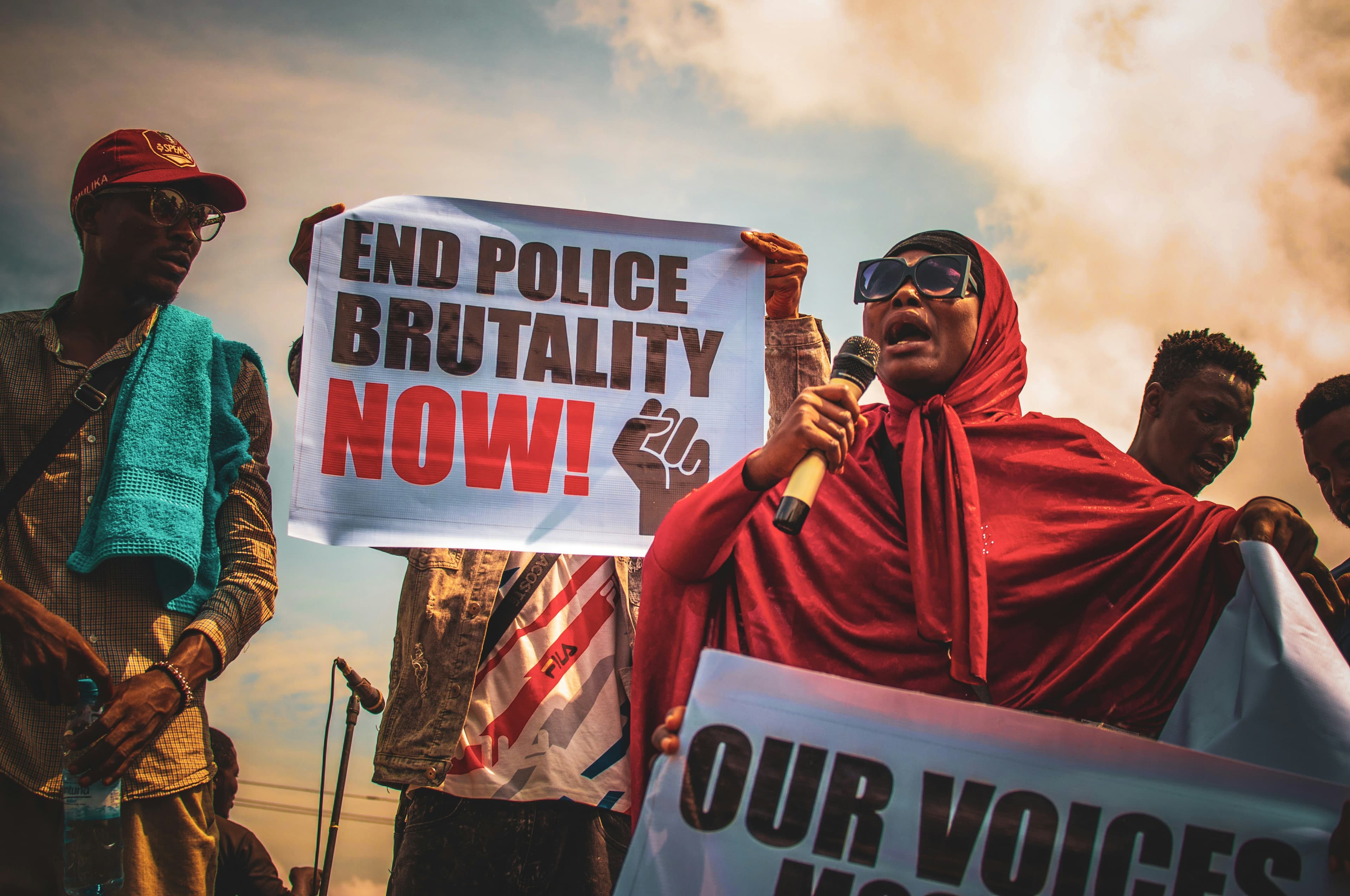
How do social movements shape elections – and how do elections reshape movements?
About
Protests and Polls (PaP) explores the reciprocal relations between two forms of political mobilisation: social movements and elections. PaP’s attempt to interrogate the interpenetration of movement and election rhythms takes issue with existing approaches that draw boundaries between both realms of contention and those that systematise the influence of one upon the other.
It essentialises key aspects of the interactional dynamics between movements and elections that have been overlooked by existing scholarship. Hence, its focus on elements that mediate the interrelations – in their symbolic, discursive, and emotional forms. PaP also acknowledges an epistemological divide that arises from the failure of African and Africanist literature to engage the two fields of movements and politics in a productive and critical dialogue.
Hence, it explores Nigeria’s 2020 #EndSARS movement, the pre-and post-election character of the Obidient movement, and the 2023 and 2027 general election cycles to theorise a much-needed African perspective on the convergence of movements and (electoral) politics. This approach will enhance our understanding of the dynamics and mobilities of contentious rhythms in the African public sphere, and how these mediate the mobilisation or demobilisation of publics behind democratic agendas.
Significance
Nigeria's 2020 #EndSARS protests are among the largest youth-led demonstrations Africa has witnessed in recent history, and the 2023 general elections stand out as one of Nigeria's most competitive elections. The Nobel Laureate, Professor Wole Soyinka, when speaking about the elections maintained that "#EndSARS was a significant momentum in the mobilisation of alternative force within the nation" (ChannelsTV 2023).
Arguably, the sequence and coincidence of events, as well as the exchanges between movement and political actors in both cycles, are rare occurrences in any country's political life. Thus, these moments are being maximised to theorise an African dimension of SM-election interrelations, which remains relatively overlooked in social movements research.
Although focused on the Nigerian context, this study will uncover new socio-political underpinnings of global challenges manifesting as democratic backsliding, political apathy and negative politics in Africa. In a decade marked by pronounced forms of autocracy, military takeovers, misinformation and speech censorship, this study will point civil society and legislative actors to institutional and socio-cultural requisites for the resilience of democracy in Africa. In a post-pandemic digital age, this study emerges as a bridge between traditional SM theories and extant expressions of digitally-mediated contention.
Data and methods
PaP adopts a constructionist, ethnographically informed approach rooted in political sociology and affect studies. This approach combines interviews (biographic narrative interviews and semi-structured interviews), participant observation and visual and textual analysis.
Outputs
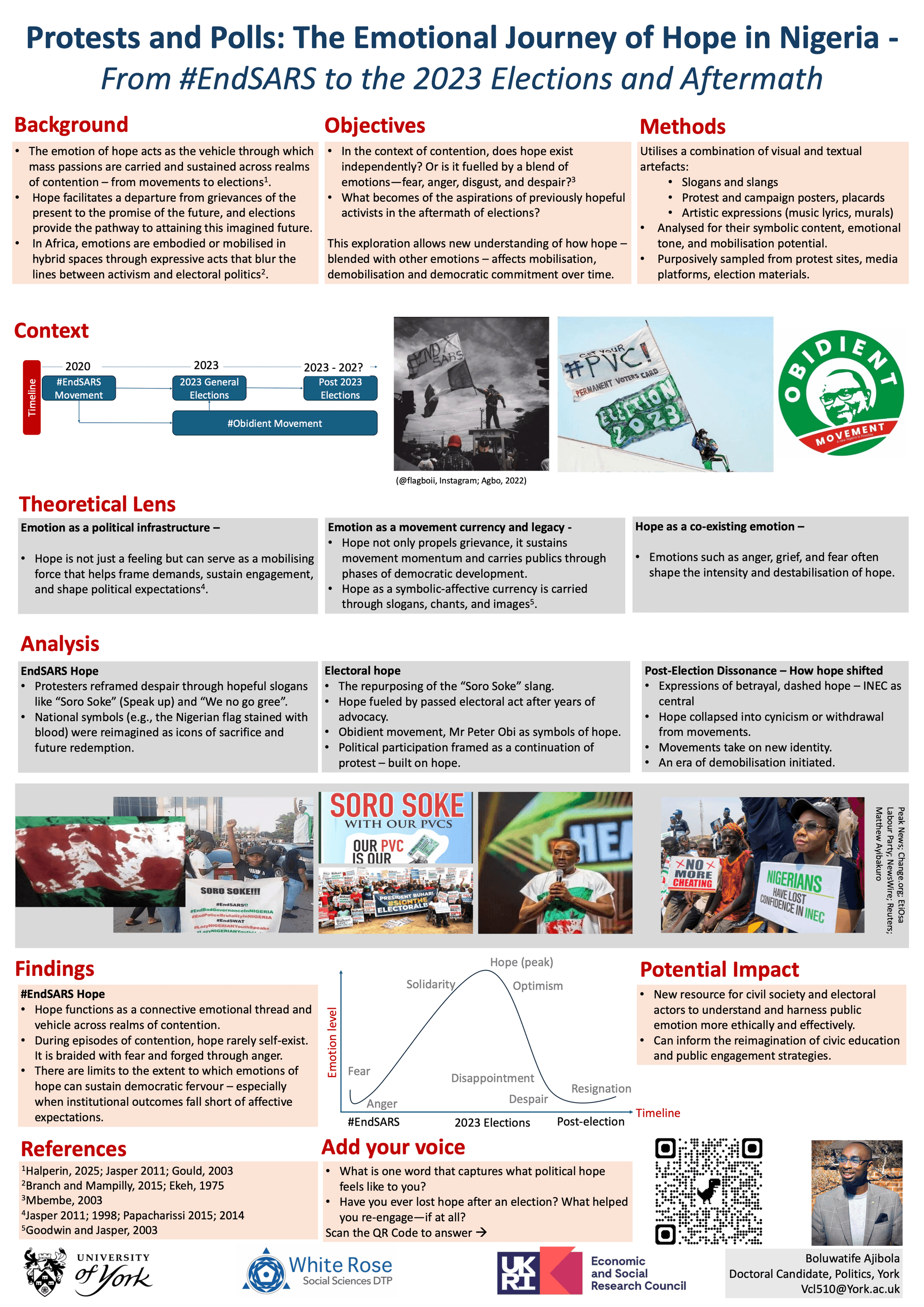
Poster presentation at the 2025 WRDTP conference
This poster visualises hope as vehicling emotional currents from protests to polls, from despair to renewed or even diminished engagement.
Conference presentations
- Youth in sustained action: Activist biographies at the intersection of development deadlock and developmental aspirations in Nigeria.
Development Studies Association Conference, UK. - Tracing activist trajectories between democratic origins and futures: A biographical approach.
Lagos Studies Association Conference. - When social movement legacies become political capitals: Exploring an African dimension to social movements-elections interrelations.
PSA 75th Annual International Conference, Birmingham, UK.
Fieldwork in Nigeria
From January to March 2026, I undertook a major phase of fieldwork in Nigeria conducting interviews and observations on how social movements and electoral politics intersect. I met with a range of actors including civil society actors, movement leaders, political and non-partisan activitsts, and political party members, affiliates, and consultants. On the field, I examined how discourse, symbols, and emotions shape mobilisation and democratic engagement across protests and elections.
Watch this space for findings and publications from this research.
University of York